
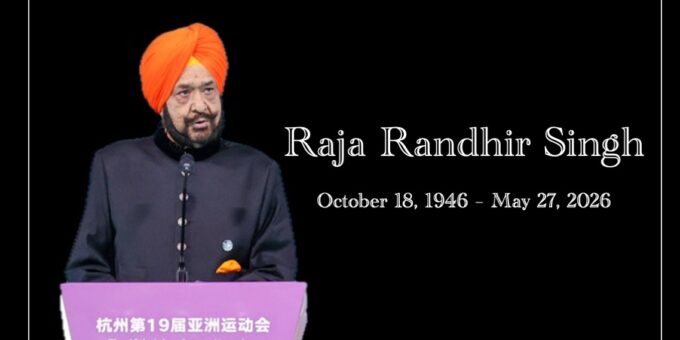
Randhir Singh had a ringside view of sport for nearly than six decades, first as a scion of the Patiala royal family, then as a Trap Shooter who competed in five Olympic Games and won an Asian Games gold medal, and eventually as a sports administrator. He made a good fist of it, helming the Indian Olympic Association through some turbulent times. India has lost a towering figure in his passing on May 27.
Of course, he was from the House of Patiala but never flaunted his royal stock. He surely had a stately and regal personality, his aura stemming as much from his knowledge and eloquence as from the humility and dignity that was second nature to him. It will not be an exaggeration to say that he was one of a kind, a unique personality in Indian sport.
He would be at ease with athletes of all disciplines, even if Cricket and Shooting were his favourites. He was a fantastic raconteur, dipping into his bag of stories and finding an apt one all the time. There were some that he would narrate with a wink and in a whispered tone, but that would lead to boisterous laughter.
Along with Dr. Karni Singh of Bikaner, Randhir Singh ensured that Shooting Sport did not sink owing to lack of resources in the early years of independent India. They were pioneers of Trap Shooting and in many ways the inspirations for several generations of rifle and pistol shooters as well.
Randhir Singh’s best show in the Olympic Games came on debut in 1968. He shot 192 to finish 17th, a bleeding surgical wound put paid to his aspirations in 1972 when he managed 173. A heavy wind in Montreal brought every shooter’s score down and Randhir Singh managed 175 to be tied 21st. He was 21st again when he shot 186 in Moscow and finished tied 35 th in Los Angeles in 1984, his final Olympic competition.
He then stepped into sports administration, taking to it like a duck to water. Having started as President of the Delhi Athletics Association in 1983, he quickly rose to be elected as the Indian Olympic Association Secretary-General in 1987. He held that position for 25 years. He was also the Olympic Council of Asia Secretary-General from 1991 to 2015.
He was witness to some spectacular performances by individual athletes, beginning with Leander Paes’ bronze medal in 1996 in Atlanta, Karnam Malleswari’s feat in year 2000 of being the Indian woman to win an Olympic medal, Rajyavardhan Rathore’s Double Trap silver in hallowed Athens in 2004 and Abhinav Bindra’s historic gold in Beijing in 2008.
He earned enormous respect in the international sports community, using his position as an Olympian first and later as International Olympic Committee Member in India to raise India’s stock. Combined with his awareness of socio-political reality and eloquence, his diplomatic skills would have done the best of career Ambassadors proud.
Almost as soon as he became an IOC Member in 2001, he was made part of the Olympic Games Study Commission. It made many of recommendations to reduce the cost of hosting the Games, not the least being the development of venues in clusters and temporary installations rather than permanent construction where legacy requirements are less than Games’ needs.
Back in India, though his partnership with Suresh Kalmadi in IOA was not as strong in their final years in office, they provided fearless leadership, unhesitatingly, if unsuccessfully, opposing some moves by the Ministry of Youth Affairs and Sports. Randhir Singh would rustle up support from the Olympic Council of Asia and the International Olympic Committee.
Even a time when his relationship with Suresh Kalmadi was not the best, he stood up in support of the Commonwealth Games 2010 Delhi and authored a strong article for a leading newspaper. He was particularly critical of those who dismissed the Commonwealth Games as a wasteful extravaganza. It was a veritable lesson in team-work and leadership.
Not surprisingly, when in 2021 a Swiss Court convicted Sheikh Ahmed Al-Fahad Al-Sabah for forgery, the International Olympic Committee banned him for 15 years and indicated Randhir Singh as its preference to head Olympic Council of Asia as its President. He was Acting President until 2024 when he was elected to that office.
There was justifiable pride in his heart that he was head of Olympic Council of Asia during the Hangzhou 2022 Asian Games in 2023. Little did we know that his health would force him to demit that position earlier this year and that he would pass a few months before the Aichi-Nagoya 2026 Asian Games.
His magnificent legacy will last a long time in Indian sport. For, he made sure that his unique ringside view of sport would benefit the larger sporting community in the country. Indeed, in many ways, Randhir Singh was the prince who ruled over the hearts of all those who loved sport in India.
