
The sigh of relief in the corridors of power after India leapt over Uzbekistan to fourth place on the Aichi-Nagoya 2026 Asian Games medal table was not just audible but continues to echo even a few days after the curtains were rung down. The celebrations have been muted as dreams of a higher than fourth place finish lay shattered.
Any ideas of closing the gap with China were laid to rest after a dull first week. And, though there was a surge in the second half of the Asian Games through Archery, Boxing and Wrestling besides Hockey, India’s sports officials’ fingers were aching from keeping them crossed over extended periods of time.
Some took refuge in the fact that some disciplines and some events in other disciplines were dropped from the Asian Games schedule this time. India won a total of eight medals in these disciplines and events. But the absence of these events from the schedule was compensated by the inclusion of other disciplines and events.
Of course, India had only 350 medal possibilities in Aichi-Nagoya 2026 Asian Games, a drop from the 401 starts the last time, its athletes won 85 medals when compared to the 106 won in Hangzhou 2022 Asian Games. The drop now to 80 per cent of medals won in 2023 corresponds more of less with the 87 per cent reduction in medal possibilities.
Should we draw comfort from such facts and pretend that all is well in the Indian high performance sport ecosystem? Or should we examine the reasons for stagnation, if not decline, in returns for Indian athletes – both in terms of gold medals and total medals? If we want to proclaim ourselves a sporting nation, we must introspect deeply rather than superficially.
While we must cherish every medal won in the Asian Games, it will be pertinent to have greater focus on Olympic disciplines and events when assessing India’s place in the global sports firmament against the twin backdrops of Aichi-Nagoya 2026 and LA28, as the impending Olympic Games has come to be known.
India’s medal haul from only Olympic disciplines and events in the Asian Games would read 17 gold, 19 silver and 26 bronze for a total of 62 medals in 13 sport (Archery, Athletics, Boxing, Cricket, Golf, Hockey, Rowing, Sailing, Shooting, Squash, Table Tennis, Weightlifting and Wrestling).
Returning focus to the recent Asian Games itself, a critical statistic that catches the eye is the fact that India and Indians had as many as a 168 finishes in the top six. In other words, as many as 48 per cent of Indian starters finished among the top six in the Asian Games. This is up from 43.39 per cent in Hangzhou where 174 Indians finished in the top six.
It indicates that a number of athletes are there or thereabouts but finished just short of the podium in the Asian Games. An honest conversation with such athletes, their coaches and support staff may offer insights into what needs to be done to close the gap and improve conversion. But sadly, we have got used to tales of those finishing fourth being ticked off by executive officers.
That statistic also tells us that some of India’s investment in developing a broader range of disciplines has perhaps begun to pay off in a small way. Yet, the danger is of India’s sports bureaucracy turning off the financial tap to some disciplines like Rowing, Cycling, Judo, Gymnastics, Swimming etc. but waking up closer to Doha30.
Speaking of the Sports Authority of India, there is an urgent need to stop speaking about, if not flaunting, the amount spent in funding training of and competition for athletes. Besides, the Ministry and SAI must also follow their own guidelines after selection criteria have been laid down by the Federations and endorsed by the Sports Authority of India/Ministry itself.
And as far as long-term plans go, India must pay attention to junior development programmes across disciplines. And these must not begin and end with so-called talent identification programmes but must include extensive training and competition plans over the next 8 to 10 years. Besides, the sooner India works on enhancing its coach development programmes the better.
With little interference from but total support of the Ministry of Youth Affairs and Sports (and its field arm, Sports Authority of India), National Sports Federations must get their act together now or risk becoming irrelevant soon. The lessons from Aichi-Nagoya 2026 must be learnt quickly and employed in preparing for Doha30 and Brisbane32.
There can be no doubt that India must become leader in Asia before aspiring for a top 10 slot in the Olympic Games. A nation needed 12 gold medals to be in top 10 in Paris 2024. Or 4 gold medals to be in the top 20. It may come across as a cruel reminder to the mandarins of Indian sport, but 13 Asian countries won at least one gold medal in Paris whereas India had none.
Archery, Athletics, Badminton, Boxing, Cricket, Hockey, Shooting and Wrestling are some disciplines in which India can aim to win gold medals in Los Angeles. If India has to get four to 10 gold in LA28, much work has to be done between now and July 2028 to ensure that India’s athletes are primed to mount a challenge to win multiple gold medals across disciplines.
The moot question is: Who will take charge and oversee the planning and execution?
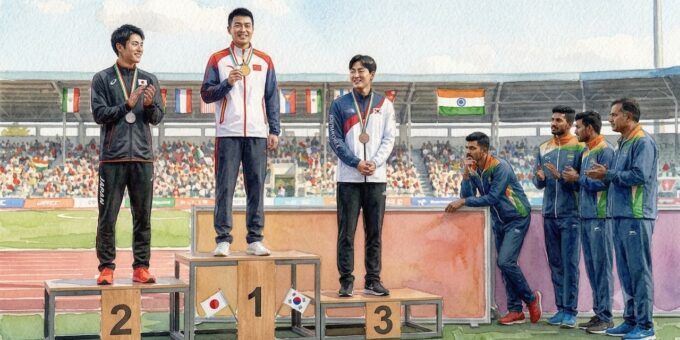
Image: An AI created graphic for illustration purposes only
