
Listen carefully and you will hear a cacophony of noises, ostensibly backed by flawed spreadsheet evaluations, beginning to blame athletes in the wake of the Asian Games. Worse, it also attempts to shield Target Olympic Podium Scheme (TOPS) leadership from its own accountability, by citing the funds made available to elite high performance athletes.
This came to the fore in a background note shared at an informal media briefing (for select outlets) by officials of the Ministry of Youth Affairs and Sports on Thursday. Among other things, it identified four ‘Key Performance Gaps’. Matters of selection and preparation were overlooked, almost as if the athletes alone were to blame for the inability to raise their game.
The note states that despite spending Rs. 27.16 crore on 34 prominent athletes in 9 different disciplines (like badminton and shooting), they did not produce performances expected of them. Then, it mentions that Indian athletes did not retain 20 gold medals in seven disciplines, citing men’s doubles in Badminton and men’s team event in Squash as examples.
While it mentions 41 medals won by 106 first timers in the Asian Games, it finds it important to highlight the fact that 89 experienced athletes competing in 23 disciplines returned without a medal. And, finally, it also trains its sights on 9 athletes who picked up injuries either before or during the Asian Games.
To say the least, that note comes across as essentially the work of a data cruncher who knows more features of excel sheets than understands the nature of sport.
Funding vs. podium finishes: A flawed correlation
Just as many athletes who have been funded by TOPS did not secure podium finished in the Asian Games, so many who were not similarly funded earned themselves and the country medals. To draw a correlation between the support given (or not) under TOPS with medals is a clear indication of lack of awareness of the competitive nature of sport.
The note makes it sound like TOPS funds have been used by 34 prominent athletes only for Asian Games. The officials had to revisit their own document, Aiming for Aichi Asian Games, where they revealed that Rs 51.92 crore had been sanctioned for athletes under TOPS and share a long list of achievements of the Indian athletes after the Paris 2024 Olympic Games.
Then again, if money could translate to medals, would not many nations from As higher on the medal table than India?
As an aside, while Aiming for Aichi Asian Games document reveals that there are 77 athletes in TOP Core group, 78 in TOPS Development group and 48 in Target Asian Games Group (TAGG) for a total of 203, the lists available of the SAI website add to 195 (48 in 8 disciplines in Core group, 102 in Development and 45 in TAGG).
How TOPS-supported athletes performed
Let us examine the performances of 35 athletes who were cleared to compete in eight disciplines in the Asian Games and are listed among the 48 TOPS Core group sportspersons. These athletes in Archery, Athletics, Badminton, Boxing, Shooting, Table Tennis, Weightlifting and Wrestling played their part in winning 21 medals, including 6 gold, 11 silver and 4 bronze.
And, if we add the two gold won by Hockey teams, this rises to 23 medals, including 8 gold in nine disciplines. Significantly,14 TOPS Core group athletes secured individual medals, including 3 gold, 8 silver and 3 bronze.
Let us expand our survey to the athletes in TOPS Development group. As many as 43 sportspersons from this group competed in the Asian Games and won 13 medals. And there were five medals for 25 athletes in the Target Asian Games Group (the list disappeared from public view a few months ago but resurfaced quite recently).
Structural questions need to be addressed
If anyone expected that all athletes on the three lists would return home with medals, they had pegged their expectations wrong. We hear of a review of the Asian Games with the National Sports Federations. Who will review the functioning of TOPS or its unquestionable relationship with athletes, superseding the Federations in many instances?
A total of 137 athletes in 16 disciplines competed for India in the Asian Games but got no medals. These included Canoeing and Kayaking (19), Cycling (14), Equestrian (7), Esports (15), Fencing (20), Gymnastics (1), Judo (3), Karate (2), Tennis (7), Teqball (3), Rugby Sevens (13), Sport Climbing (2), Surfing (4), Swimming (12), Taekwondo (3) and Volleyball (12).
Can it be truthfully said that all these athletes secured the qualification norms laid down by the Ministry?
The officials in the Ministry will have to ask themselves why the meetings of the all-important Mission Olympic Cell have not been as frequent and fruitful as in the previous Asian Games cycle. The result of a top gun holding dual charge has led to too much power being vested in one other official and with such consequences.
Leaders in the Ministry would also have to ponder if they enforced the National Sports Federations’ selection criteria in an even, fair and transparent manner across all disciplines. They will have to consider if 60 medals were won in five disciplines (Athletics, Shooting, Archery, Boxing and Wrestling) in which its own officials did not wield as much clout as in other sports.
Who approved fathers to travel with the contingent as personal coaches of athletes? Did those who cleared the coaching personnel and support staff to travel at Government expense pause to ask the question if these parents were indeed sports coaches? Why would such questions not be part of any honest introspection?
Sports is played on the field, not spreadsheets
Indian sport will give itself a better chance at succeeding globally when the Ministry, specifically TOPS, prevents athletes from believing they are bigger than their respective National Sports Federations. The superiority complex worn by TOPS often turns out to be counter-productive and corrodes the machinery rather than facilitate its efficient functioning.
Clearly, sport is not played on Excel sheets and board rooms. Athletes will have to show up and perform. And the only time anyone can hold a grouse an athlete is when he or she has not made their best effort at the highest stage this year.
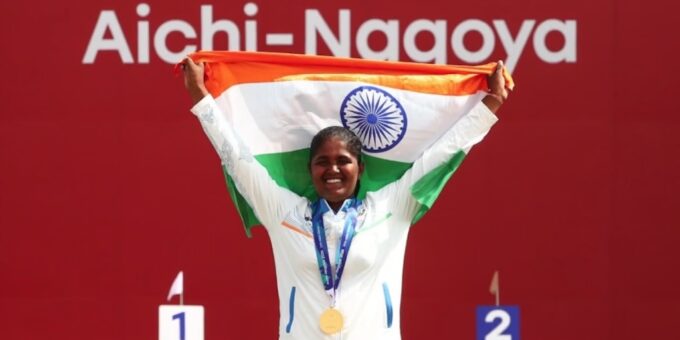
Image (for illustration purposes only): Kumkum Mohod, Recurve gold medalist (Photo courtesy: AINAGOC)
