
Even a voice as powerful as Rohan Bopanna’s rises in support of Tennis players Sahaja Yamalapalli, Vaishnavi Adkar, Manas Dhamne, Prarthana Thombare and Vaidehee Chaudhari who were not cleared to compete in the Aichi-Nagoya 2026 Asian Games, a strange silence greets four women rowers who have met similar fate.
Bharati Devi Oinam and Priya Devi Thangjam (Double Sculls) and Diljot Kaur and Suman Devi (Coxless Pair) are training in Army Rowing Node in Pune, unsure of what else they could have done to secure the Ministry of Youth Affairs and Sports’ nod. Three of these four rowers made it to the podium in the Asian Rowing Cup in Chungju, South Korea, in April this year.
The genesis of the problem lies in the absence of qualifying norms for the Asian Games by the event owner, Olympic Council of Asia in this instance, unlike in the Olympic Games where the International Olympic Committee and the respective International Federations come together and specify qualifying criteria.
Since there has been a history of some National Sports Federations sending squads to the Asian Games for exposure rather than with any hope of turning in a good performance, the Ministry of Youth Affairs and Sports advised the Federations to draft criteria while itself instructing them to follow prescribed benchmarks.
So what do the Ministry of Youth Affairs and Sports’ Selection Criteria, issued in September last, say?
As far as measure individual sport and events are concerned, the (respective) National Sports Federation will be eligible to nominate an athlete (or combination) if the athlete has matched or bettered the sixth place performance from the last Asian Games at a competition recognised by the International Federation held within the 12 months preceding the coming Asian Games.
Therefore, the simple test to see if the two rowing teams deserved to go to the Asian Games or not is to see if they have better the times of the sixth place performance in the last Asian Games. The corresponding time for the Women’s Double Scull in the Hangzhou 2022 Asian Games was 7:33.33 while there were only three Coxless Pair boats, the bronze medal going at 7:47.62.
The answer to the question if the Indian teams in these events have matched or bettered the sixth place times of the last Asian Games is a resounding yes.
In Double Sculls, Gouri Nandana and Thangjam Priya Devi produced a best time of 7:51.97 in the 2025 Asian Championships in October last while Poonam and Thanjam Priya Devi won bronze in 7:49.29 in the 2026 Asian Rowing Cup in April. However, Oinam Bharti Devi and Thangjam Priya Devi came up with a 7:29.18 effort in the 2026 World Cup III in Lucerne in June.
In Coxless Pair, Suman Devi and Aleena Anto clocked 7:54.25 in finishing fifth in the 2025 Asian Rowing Championships, Suman Devi and Diljot Kaur teamed up to win bronze in 8:02.384 in the 2026 Asian Rowing Cup in April before improving to 7:36.17 in the 2026 World Cup III in Lucerne in June.
It must be said that the World Cup III is not the only time that the women’s teams clocked times that were faster than the sixth place times of the last Asian Games. The Double Scull team of Bharti Devi and Priya Devi achieved 7:28.46 and 7:23.84 in the Bled International Regatta in Slovenia and 7:21.07 and 7:51.60 in the Holland Beker Regatta in Amsterdam.
The Coxless Pair team of Suman Devi and Diljot Kaur produced times of 7:48.84 and 7:48.34 in Slovenia and had a 7:51.18 effort in one its three races in Amsterdam.
By seeming to assess the women rowers’ eligibility only on the basis of performances at the Asian Championships in 2025 and ignoring the recent efforts in competitions recognised by World Rowing, the officials, especially those manning the Target Olympic Podium Scheme, seems to have given up the possibility of the two teams being in the mix for podium finish in Aichi-Nagoya.
Truth to tell, nobody can guarantee a medal in sporting competition. Even the world’s best cannot just show up and be assured of a medal. The athlete will have to perform better than others on the given day to lay claim on the piece of precious metal; but by not showing up for the competition, the only certainty is of not being in with a chance to fight for a podium finish.
Sometimes a calculated risk has to be taken, especially in events in which there is not much competition. It also does not make sense that an athlete or a team is judged on the basis of results obtained in a continental championships last year rather than on current form. It is a pity that the thinktank did not find it important to shift perspective and consider the rowers’ case favourably.
More so, when some disciplines seem to be able to send large squads even if their athletes have not individually met the qualification criteria but, by some calculation appear to make the grade as a team. And when some other disciplines convince manage sizeable team strength because officials have to justify the spends on them over the years.
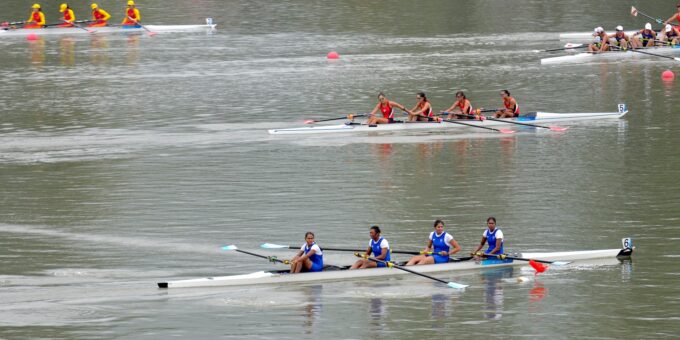
Photo (for illustrative purposes only): India women’s Fours team, Hangzhou 2022 Asian Games

An important piece. What troubles me most is not simply that four deserving athletes have been left out, but the larger question this raises about how we assess sporting potential.