

Minister of Youth Affairs and Sports Mansukh Mandaviya told the Lok Sabha on Monday that the implementation of the recommendations of the Task Force on Unified Framework for Development of Coaching Ecosystem in India will be done in a phased manner. It is a good guess that the sports ecosystem will be hoping the implementation begins sooner than later.
“Initial steps such as the establishment of National Coach Accreditation Bureau (NCAB) and the finalisation of the unified curriculum are envisaged in the short term, followed by the roll-out of licencing and tiered pathways,” he told Lok Sabha in response to questions by 10 members from three political parties.
“NCAB has been envisaged as the apex authority responsible for setting standards for coach education and accreditation, approve and monitor coaching pathways, accredit coach education institutions, design a unified core curriculum across sports, oversee licensing and renewal of coaches, and ensure quality assurance and alignment with National Skills Qualifications Framework and National Education Policy 2020,” he said.
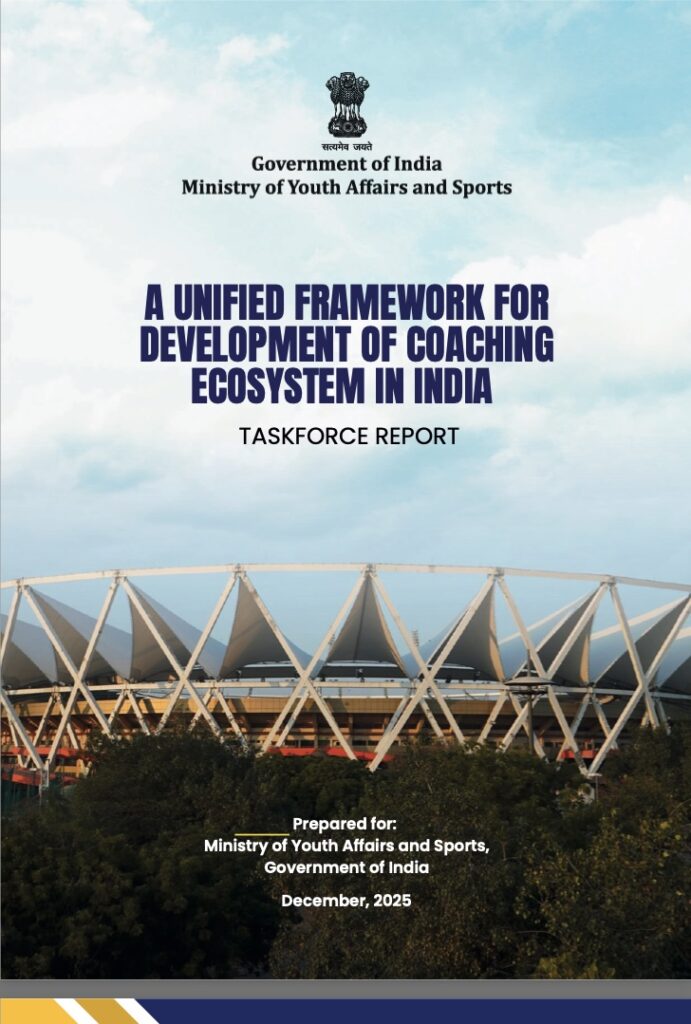
The report of the Task Force, chaired by Pullela Gopichand, easily one of India’s thought leaders on sports coaching, could not have made its point more forcefully than by stating that while India’s sporting ambitions have grown exponentially over the past decade, Coach development systems have not kept pace with these national aspirations.
“The absence of a strong indigenous system has created a situation where India lacks sufficient quality coaches at grassroots, intermediate, and elite levels,” it says. Undoubtedly, India has paid little attention to ensuring that the basics are taught right at the grassroots level. That raises fundamental questions if the coaches and physical education teachers who double up as coaches in schools have developed the capacity to impact the basic lessons right to their trainees.
The National Institute of Sports has produced nearly 25,000 coaches with a one-year sports coaching diploma programme, launched in 1963. It also has a six-week certificate course in coaching, the latest cohort (December 2025-January 2026) alone having a whopping 4930 candidates, has churned out countless more coaches.
The Olympic Task Force, appointed by Prime Minister Narendra Modi in the wake of Rio de Janeiro 2016 Olympic Games, noted that a large number of coaches remained either unemployable due to poor skills or unemployed due to limited openings, It is no secret that the quality of coaches impacts the quality of athletes emerging in the high performance pathway.
Mention of the Olympic Task Force makes us recall that it had made such recommendations in 2018, but no action was initiated to implement them. It had suggested a Coach Development Board to define and execute the National Coach Development Programme, including testing, certifying and registering coaches and recertifying them every four years.
Besides, the Olympic Task Force had recommended that that a mechanism and pathway to nurture individuals to take up coaching as a profession. It also suggested a revamp of the curriculum offered by the Netaji Subhas National Institute of Sports since it did not respond to the needs of the 21st century athlete.
After nearly eight years of virtually no action on such recommendations, another panel has made its own suggestions. Hopefully, there will be some implementation at least now. There can be no denying that if India is to hasten its journey towards being a better sporting nation, it must begin work on improving the quality of coaching, especially at the grassroots level.
It is truly up to the officials of the Department of Sports to ensure that coach development, one of the most important cogs in Indian sport’s wheel, is in shape. Their focus on governance matters and infrastructure development over the past few years may have relegated the urgent need to enhance coach education and development away from the spotlight.
All stakeholders will have to identify their roles and play them and in unison so that this piece of the jigsaw does not go missing or is wrongly placed. India will then have taken the steps that can hasten its evolution as a sporting nation. If indeed India wants to catapult itself to the world’s best sporting nations, it must pay more attention to coach development.
The Task Force report reaffirms what it called a sobering truth: “India’s work on structured coach development has barely begun. The ecosystem is fragmented, inconsistent, and heavily dependent on individual effort rather than institutional strength. A proliferation of courses, universities, international certifications, and private training programs—while well intentioned—has created confusion rather than clarity,” it says.
“The purpose of this document is not simply to recommend changes, but to articulate a direction. A direction where India builds a world-class coaching system. This restructuring is not an option—it is an opportunity. An opportunity to rebuild the very foundation of Indian sport. The time to act is now,” it says.
Hopefully, officials in the Department of Sports will soon draw up specific timelines to ensure that the suggestions are actioned upon at the earliest. That becomes imperative since India aspires to break into the top 10 on the Olympic Games medal table in 2036, irrespective of where it is held.
Feature Image created with Copilot
