
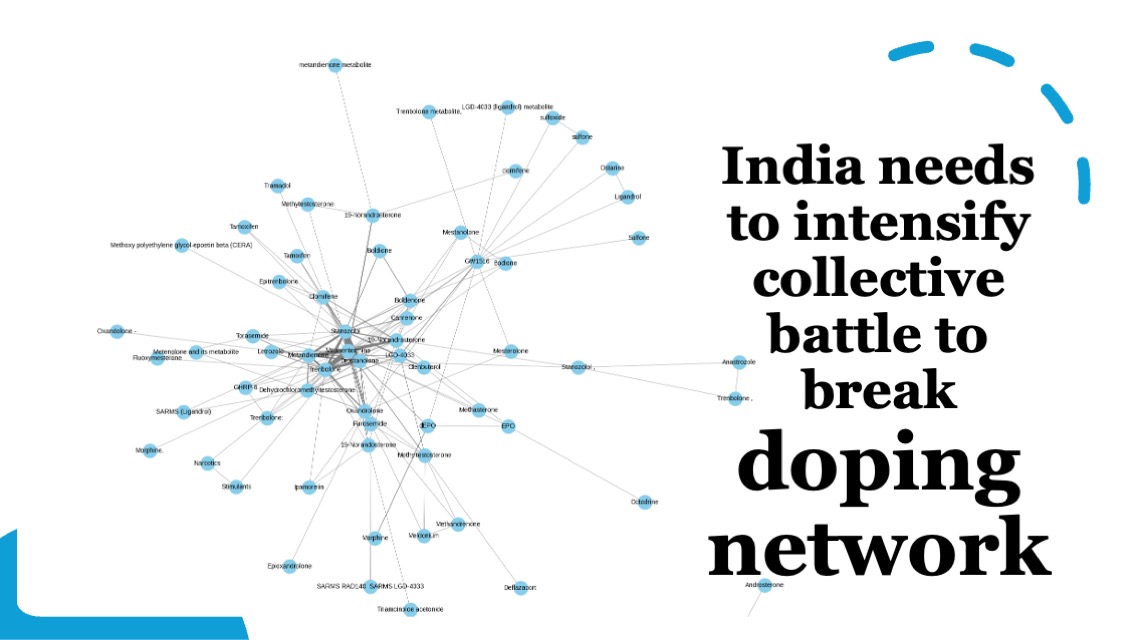
As many as 550 Indian athletes are currently ineligible to train and compete in sporting activity. These include 215 banned by National Anti-Doping Disciplinary Panels (ADDP), 252 who quickly admitted committing ADRVs and agreed to face ineligibility periods and 83 who are on provisional suspension pending disciplinary proceedings.
The defence offered by the athletes ranges from medication taken in doctor’s advice to contaminated supplements and will make for an interesting study when juxtaposed with the data on the prohibited substances found in the athletes’ samples but there seems to have been no effort in this direction by the National Anti-Doping Agency (NADA).
There are quite a few Indian athletes who have been sanctioned by other anti-doping organisations like the Athletics Integrity Unit and the International Testing Agency. Of the 550 athletes who are currently ineligible to train and compete, 158 are from Athletics. That number is bound to be high considering that NADA tests athletes from track and field more than in other disciplines.
The Weightlifting-Powerlifting combine accounts for 140 instances while 114 are from the three combat sports of Wrestling, Boxing and Judo. Kabaddi (22), Bodybuilding (20), Wushu (18) and Canoeing (10) complete the dubious top 10 disciplines. Nearly two dozen athletes have faced or are facing sanctions for evasion or refusal to provide samples.
With an idea of the disciplines in which the most infractions have been found, it is imperative that we spend some time analysing the substances detected in the samples of these 457 athletes currently banned from sport. If nothing else, it may point at directions in which preventive measures need to be taken by everyone, including the larger medical and nutritional ecosystem.
The entire gamut of banned substances – Anabolic Agents, Peptide Hormones, Hormone and Metabolic Modulators, Diuretics and Masking Agents, Stimulants, Narcotics and Glucocorticoids – have shown up in one sample or the other among the 467 athletes serving a ban at the moment. But quite clearly, some substances have been used more than the others.
Beyond the palest shadow of doubt, Anabolic Agents, classed as S1 in the World Anti-Doping Agency Prohibited List, are the most found substances in the samples of these athletes. Stanozolol (79), Drostanolone (72), Metandienone (70), Nandrolone (58) and Trenbolone (34) are the top 5 Anabolic Steroids that show up in more than 460 samples.
The high incidence of Mephentermine – both singly and in combination with steroids or diuretics – is as interesting as the occurrence of Anabolic Steroids. This notorious stimulant, classed in S6 by WADA and banned in competition, has been detected in 80 cases, including 49 in combination with other substances.
There is also enough evidence of the prevalance of blood-doping practices with 51 positives for peptide hormones, Darbepoetin (dEPO) and Erythropoietin (EPO) topping with 26 and 17 instances respectively. There has been a sharp rise in the use of dEPO since it was detected in a sample collected by NADA for the first time in 2021.
Traces of multiple substances, found in 126 samples, indicate attempts to stack performance enhancers and, in some cases, attempt to mask them. As many as five prohibited substances were detected in three samples while four banned substances were found in 13 samples. It is a wonder that athletes hoped to escape detection when loading themselves with so many banned substances.
It is also worrisome that nearly 10 per cent of these are minors – and, therefore, not named by NADA. There seems to have been little attempt to trace the supply chains which have led to 44 minors currently facing ineligibility periods from sport. Surely, they would not have procured and ingested the banned substances on their own.
Clearly, expressing indignation at the alarming rise of doping offences will not suffice. The ecosystem beyond Indian sport must do something more tangible. It can start by looking at the supply chain. For instance, the unchecked sale of medication with steroids without prescription, especially through online mechanisms, must be addressed without loss of time.
The administrative machinery must lay down – and implement – rules for import, production and sale of nutritional supplements. There must be a way to end the sale of supplements brought in from overseas and sold online. Social media platforms are rife with claims of availability of supplements sourced in Russia. These products must not slip into India unchecked.
Yes, it is time to go beyond lip-service and ensure that NADA and the National Sports Federations are not left to deal with the grim scenario by themselves. It is time for India to up its ante in the war against doping in sport. If concrete action is not taken by the regulatory mechanism and law enforcement agencies, the country may end up with more shame being heaped on it.
