
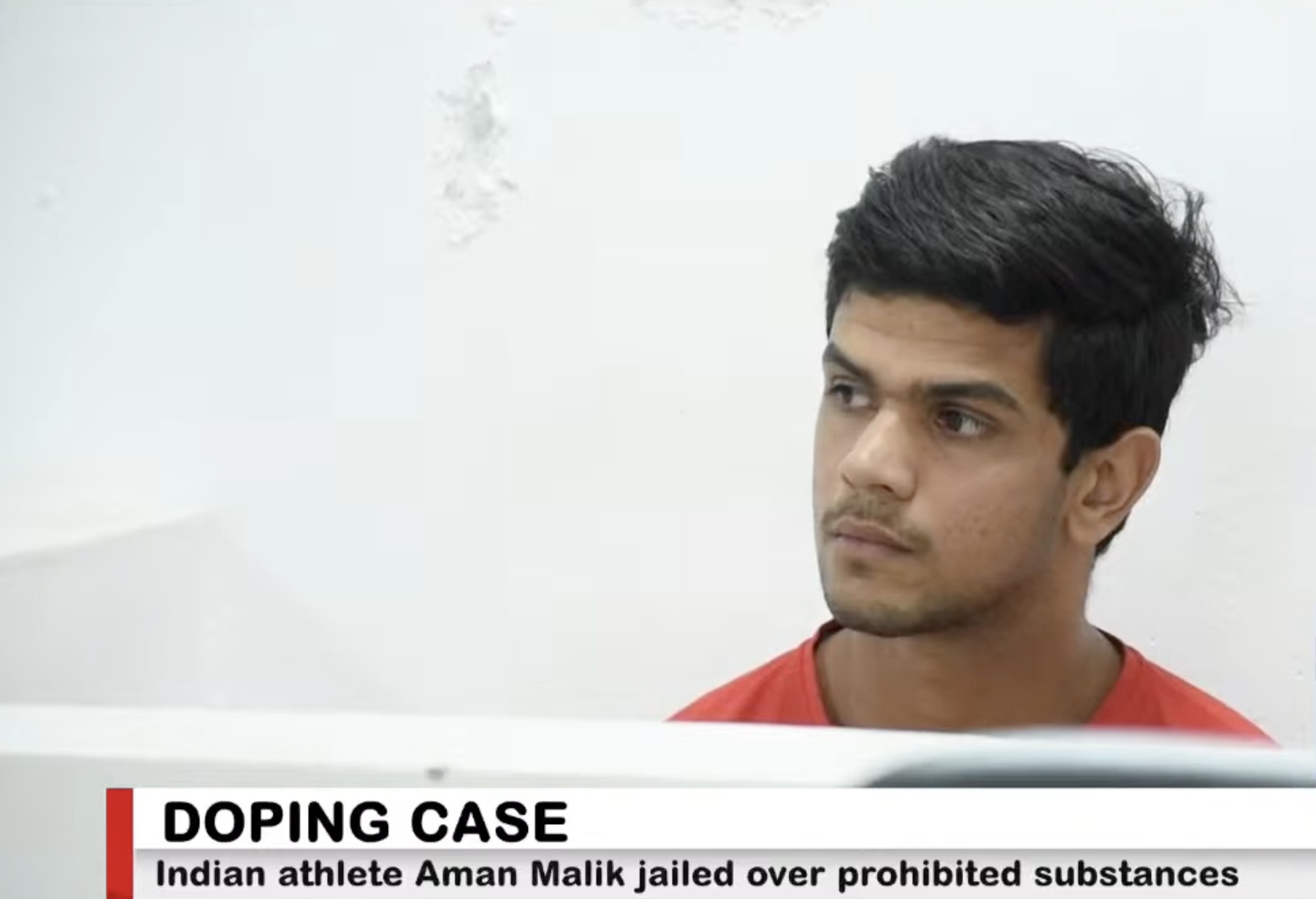
Jailed teenaged athlete Aman Malik’s story may have disappeared from the sports pages of Indian newspapers but those entrusted with leading the fight against doping must not forget it, thinking of it as a bad dream that will go away. India needs to wake up and smell the coffee if it is to win the war against one of the biggest sports integrity issues plaguing it.
Aman Malik is said to have travelled to Iten, Kenya, to train as an athlete. He carried a suitcase load of prohibited substances, supplements and medication that he could not possess since he is not a medical practitioner. These included Human Growth Harmone, Meldonium, Levocranitine, Dipryidamole, Mannitol, Insulin syringes, infusion sets and vials with erased labels.
Reports filtering in from Kenya suggest that the pro bono lawyer who appeared from Aman Malik appealed for lenience since the Sonipat lad to reached Kenya to train as an athlete and lift his family out of poverty. The lawyer sought to paint a picture of Aman Malik as a misguided youth who got involved because of a misjudgment.
The lawyer reportedly tried to convince the Court to consider a non-custodial sentence lending itself to rehabilitation, but though Aman Malik had pleaded guilty on all four counts, the mandatory sentence could not be below the minimum prescribed in the Kenyan Pharmacy and Poisons (Amendment Rules 2022 and the Kenyan Anti-Doping Act 2016.
Criminalise trafficking of prohibited substances
A couple of things emerge from this case, criminalisation of doping being one. The question begs asking: If an 18-year-old can be jailed in Kenya for trafficking banned substances, why cannot that be replicated in India? Should not those bringing prohibited substances into India from Central Asian Republics be held at the point of entry itself and subject to legal proceedings?
More than a decade ago, Justice Mukul Mudgal Committee had recommended one-year imprisonment and a fine of up to Rs. 10 lakh for any person trafficking or supplying prohibited substance to an athlete on a regular basis for commercial purposes. It also envisaged a four-year jail term for a person part of an organised crime syndicate.
However, the then IOA Secretary General Rajeev Mehta has reportedly opposed the idea and wanted that reconsideration of the idea of criminalising supply of prohibited substances. He reasoned that since the use of some substances is ‘illegal only in sports’, it would not stand the general implications of a criminal act.
Some have argued that the World Anti-Doping Agency believes that doping should not be made a criminal offence for athletes. They seem to gloss over the fact that WADA encourages Governments to introduce laws to penalise those who are trafficking and distributing banned substances; those individuals who are putting banned substances into the hands of athletes.
WADA has, in fact, acknowledged that countries which introduced criminal legislation for doping have been effective in catching athlete support personnel who possess or traffic performance enhancing drugs. “It seems that, given the threat of being imprisoned, these personnel are often more cooperative with anti-doping authorities,” WADA has said.
Of course, you could argue that criminalisation has not reduced the incidence of doping in Kenya. And there may be some merit in that, but after Aman Malik’s conviction and jail sentence, the supply chain in Kenya will be impacted. And that can possibly bring the number of dope positives down significantly.
Yet, Italy would be a good example to look at when it comes to the impact of criminalisation of doping. In 2018, it criminalised the procurement, administration, taking or promoting the use of prohibited substances; or adopting forbidden medical practices. As per WADA Reports, Italy had 157 Anti-Doping Rule Violations in 2019 and 104 in 2022.
The corresponding numbers for India were 152 and 130 respectively. The 2023 WADA Testing Figures Report offers a better comparison between Italy and India. The Rome laboratory tested 8647 samples and reported 83 Adverse Analytical Findings (AAF) and 24 Atypical Findings (ATF) while the New Delhi laboratory reported 212 AAF and 26 ATF in the 5412 samples that it tested.
Olympian Adille J Sumariwalla, erstwhile President of the Athletics Federation of India, was in the forefront of the campaign to introduce jail terms for athlete support personnel who encourage doping in sport. With 260 positives reported in 2024, it is time for India to reconsider the idea of not criminalising doping, at least for those in the supply chain.
Will India investigate Aman Malik’s handlers?
The other important aspect that needs attention is for investigative agencies to retrace Aman Malik’s steps and bring to book those who lured him to first enter into an agreement with a Kenyan distance runner to supply all that it takes for the latter to win and then procure and carry a suitcase full of prohibited substances. His handlers need to be made examples of to deter doping in India.
Would an 18-year-old have the wherewithal to enter into an agreement with a Kenyan distance runner. And then spend six months purchasing a suitcase full of performance enhancing stuff? It is more likely that he was only being a ‘mule’, ferrying the stuff for someone else who has no qualms throwing the teenager to the wolves.
If India is keen on getting off the top of the world’s most dubious list – dope positives – it must get to the bottom of this case and not ignore it. It will get enough and more leads by asking its counterparts in Kenya, be it in the Anti-Doping Agency of Kenya or in Athletics Kenya, not to speak of the investigators there.
Photo: Screenshot from KBC Sports YouTube
