

The International Olympic Committee (IOC) President Kirsten Coventry hit the pause button in the race to decide the host of the 2036 Olympic Games when she decided to review the future host election process almost as soon as she took charge in June, but the candidates, especially Ahmedabad cannot let up their preparations to showcase their intent.
It goes without saying that securing the Olympic Games is a more challenging process than getting the nod of Commonwealth Sport to allot 2030 Commonwealth Games to Ahmedabad. For, the IOC does take a more holistic view of the suitability of candidates, a far cry from the times when the voting process was mired with controversy and the Salt Lake City scandal came to light.
IOC modified the process of electing the Host City, seeking to address the diminishing field of candidates by making it cheaper and easier to bid for the Olympic Games. Yet, the then IOC President Thomas Bach’s decision in 2021 to do away with a competitive bidding process when Brisbane was picked as host of 2032 Olympic Games was not without criticism and may have cause Kirstin Coventry to think of process changes.
Irrespective of whether the selection process undergoes any change, Ahmedabad would do well to be prepared. It must be remembered, though, that the selection of the host is a more stringent process than the one IOC has adopted thus far to whittle down the 2030 Youth Olympic Games aspirants to three.
A good idea of what the IOC Future Host Commission looked for during Continuous Dialogue with Interested Parties – as prospective Host Cities are called – and independent third party sources can be had from the feasibility assessments of Asuncion (Paraguay), Bangkok (Thailand) and Santiago (Chile) which have now been identified for Targeted Dialogue.
Of course, the team – or should we make that the teams? – charged with putting together India’s bid for the 2036 Olympic Games and making it a winning one will have spent time reading up the evaluation of the 2030 Youth Olympic Games host city aspirants in the race. The critical aspects about the process and the areas that need India’s urgent attention will become obvious.
It may help to study the IOC Youth Olympic Games Working Group’s lay stress on how the three projects aligned themselves with local and national long-term plans for development, sports, education and health, to deliver a range of socio-economic benefits to the community. It gives an indication of the deep dive that IOC panels are now undertaking before making recommendations.
The key parameters have been divided into two sections – Strategic and Technical (as seen below).
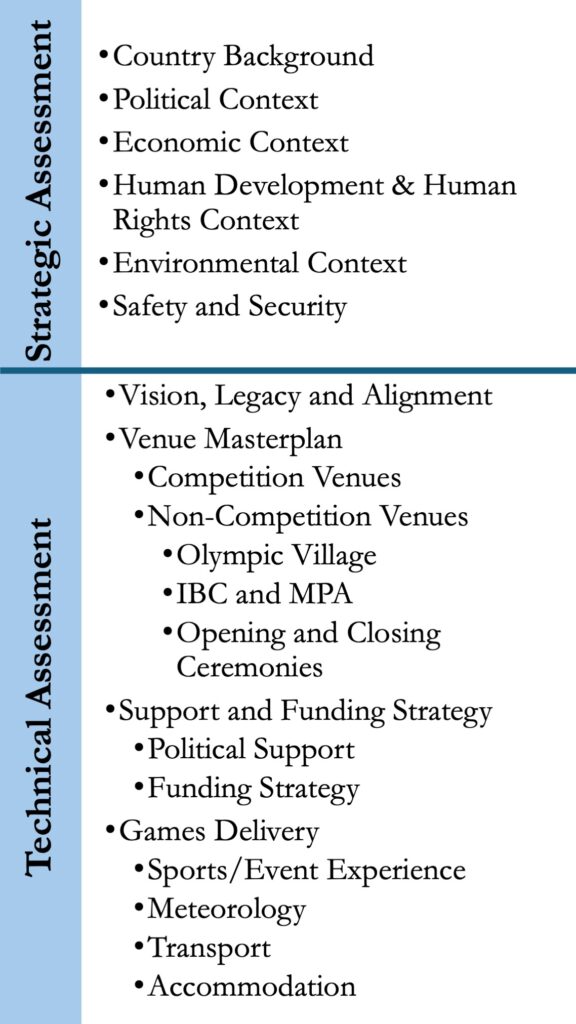
It will become apparent that that even as Government continues to develop world class sporting infrastructure in Ahmedabad, it will have to frame policy and enhance investment in a number of other areas as well to create the right image and perception of the world.
For instance, India will have to improve its ranking in some of the independent third-party indices like Moody’s (currently graded Baa3), COFACE for Trade (Country Risk Assessment marked as B and Business Climate Assessment as A4), Environmental Performance Index devised by Yale and Colombia Universities (ranked 176 in 2024).
The United National Development Programme’s Human Development Index ranks India at 130 among 193 nations and territories while the World Economic Forum’s Global Gender Gap Index 2025 ranks India at 131 among 148 economies. The IOC also looks at World Bank Group’s Worldwide Governance Indicators and data from the International Labour Organisation.
As for Ahmedabad, its TomTom Traffic Index of 43 among cities where average travel time for 10km is more than 26 minutes and 119 among the world’s most polluted cities on the IQAIR ranking should also be a matter of concern for the local authorities who must chip in to make the city’s case to host the Olympic Games stronger.
If Ahmedabad takes up the Olympic Games bid with the seriousness it deserves, even while preparing to host the 2030 Commonwealth Games, it can enhance its chances of succeeding against the bids from Doha (Qatar), Istanbul (Turkey), Santiago (Chile) and an as yet unspecificed city in South Africa.
