
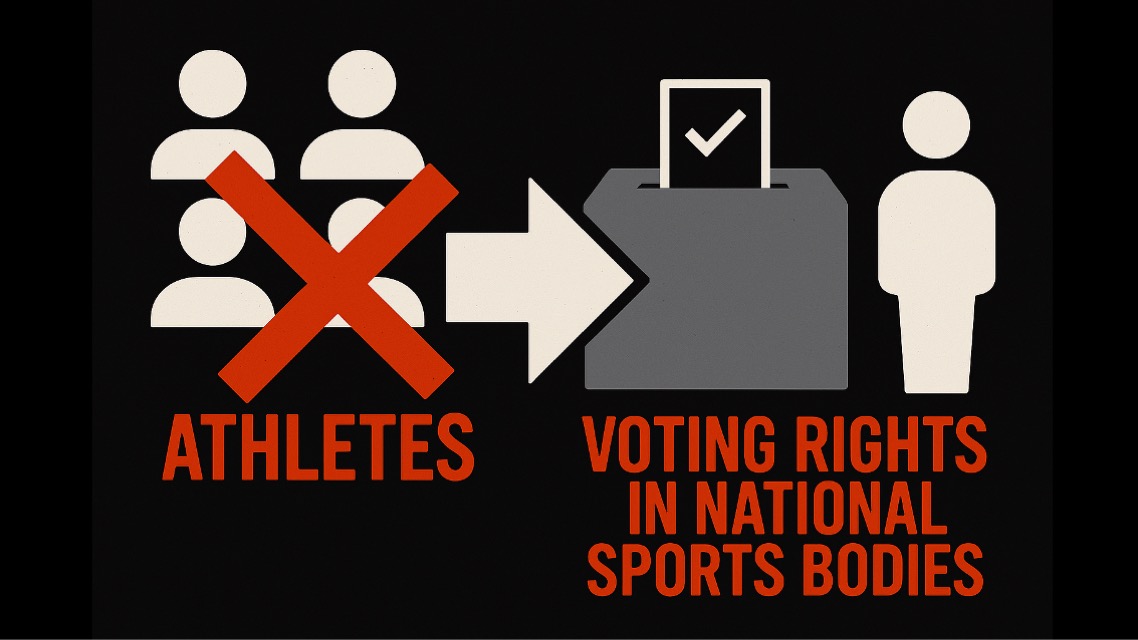
The drastic reduction of athlete representation in the General Body of a National Sports Federation and in its Executive Committee, as notified in the National Sports Governance (National Sports Bodies) Rules, 2026 is an admission that the authors of the National Sports Code were wrong in suggesting that 25 per cent of the voting rights should be vested in sportspersons.
The National Sports Governance (National Sports Bodies) Rules, 2026, now specifies that there must be at least four (or higher) sportspersons of outstanding merit as voting members in the General Body of each National Sports Federation. They have also suggested that at least one of the sportspersons of outstanding merit be a part of the Executive Committee.
After being dormant for several years, the concept of sportspersons in administration gained ground when SY Quraishi, Court-appointed Administrator of the Archery Association of India, over-reached in the redrafting its constitution in 2018. He wanted one-third of the Electoral College to be ‘eminent’ archers but did not find as many for the elections in December 2018.
It is another matter that the Supreme Court rejected the amended constitution and asked for fresh elections. While the High Court had given him powers of the office-bearers and the executive committee, he assumed he was more powerful than the general body. As things stand now, four eminent archers were nominated to the AAI General Council the last time elections were held.
The push to create a roster Sportspersons of Outstanding Merit rose to a crescendo during the IOA elections in December 2022 when just about everyone in the Indian sports ecosystem, including the Ministry of Youth Affairs and Sports, the Supreme Court and the International Olympic Committee, was involved in the process of redrafting the IOA constitution.
That process – some termed it long over-due cleansing of the system, others called it mayhem – led to an Athletes’ Commission being selected without election. Eventually that Commission ‘decided’ on the eight Sportspersons of Outstanding Merit to be sent to vote in the elections. It was a novel, if not strange, way to manage the democratic practice of holding elections.
The inclusion eight Sportspersons of Outstanding Merit in the Indian Olympic Association elections in 2022 was perhaps an over the top reaction to the state of affairs back then. Four SOMs and a member of the IOA Athletes’ Commission got elected to the Executive Committee. Two top guns of the Athletes’ Commission were also included.
Sports administrators, including former athletes with a leaning towards administration, must have a similar pathway to athletes who progress from clubs to district teams to state teams to the national squad, Instead, ex-athletes were fast tracked to sports administration in the belief that they can usher in transparency and fair play in the governance of National Sports Federations.
Missed chance to specify process of Athlete Commission election
As of now, the authors of the Rules seem to have overlooked the chance to standardise the process of formation of Athletes’ Commission across the sports bodies, perhaps with the intention of letting them follow the format adopted by their respective International Federations. But the Ministry would know well that the elections to the Athletes’ Commissions are a rarity.
Most International Sports Federations conduct the elections to their respective Athletes’ Commissions during a World Championships and have laid down eligibility criteria, including requiring the candidates to have competed in at least one of the two last World Championships or Olympic Games. Their nominations have to be presented by their respective National Federations.
Scope for greater uniformity in governance structure but need for consistent enforcement
There is a chance that this development will lead to greater uniformity in the composition of the Executive Committees of the National Sports Federations. Then again, the National Sports Development Code of India 2011 had also laid down specifications, but the Ministry overlooked quite a few who did not comply with the regulations in the Code.
Some found their own innovative ways around the stipulations of the Code. As recently as in 2024, one National Sports Federation elected an executive committee of 19 members – a senior vice-president, 8 vice-presidents and 7 joint secretaries besides a president, secretary-general and a treasurer. It did not seem to matter to the Ministry of Youth Affairs and Sports.
Another Federation, whose election was held in 2025, formed not only a 15-member Executive Committee but also a 25-member Governing Body with seven Vice Presidents, six Joint Secretaries and 12 Governing Body members but the Ministry officials, alert to transgressions by some Federations, preferred to look the other way.
Come to think of it, a lot of the Rules laid down have been drawn from the Sports Code, the Holy Grail for sports governance till earlier this week. While it is true that a one-size-fits-all approach does not work, it is clear that the Rules must be enforced uniformly across all organisations coming under their ambit.
