
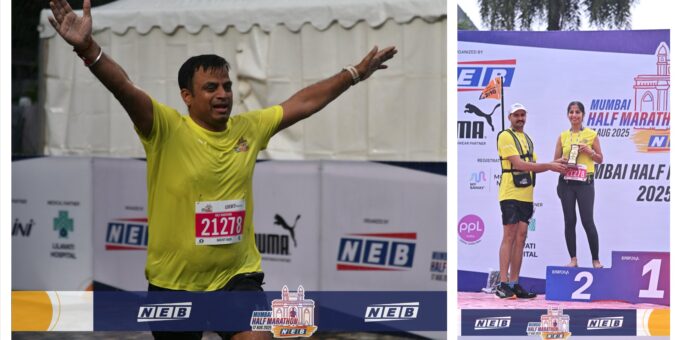
Is doping the biggest of integrity concerns in the countless distance running events in the country? Certainly not, if the number of participants who are sanctioned by race organisers for bib swapping is taken into account. The Tata Mumbai Marathon 2026 has seen 51 disqualifications and the Cognizant New Delhi Marathon 2026 has listed 14 runners for violating the bib rules.
Sample these: a woman runner had no qualms claiming the runner-up trophy in the Mumbai Half Marathon 2025 and posing for photographs after a man ran the race with her bib (featured photo above). An IIT alum and health coach had no hesitation in borrowing a bib registered against the name of Kalyan Sahay Dodwadiya, apparently to pace some other runners in the New Delhi Marathon 2026 (see photo below).
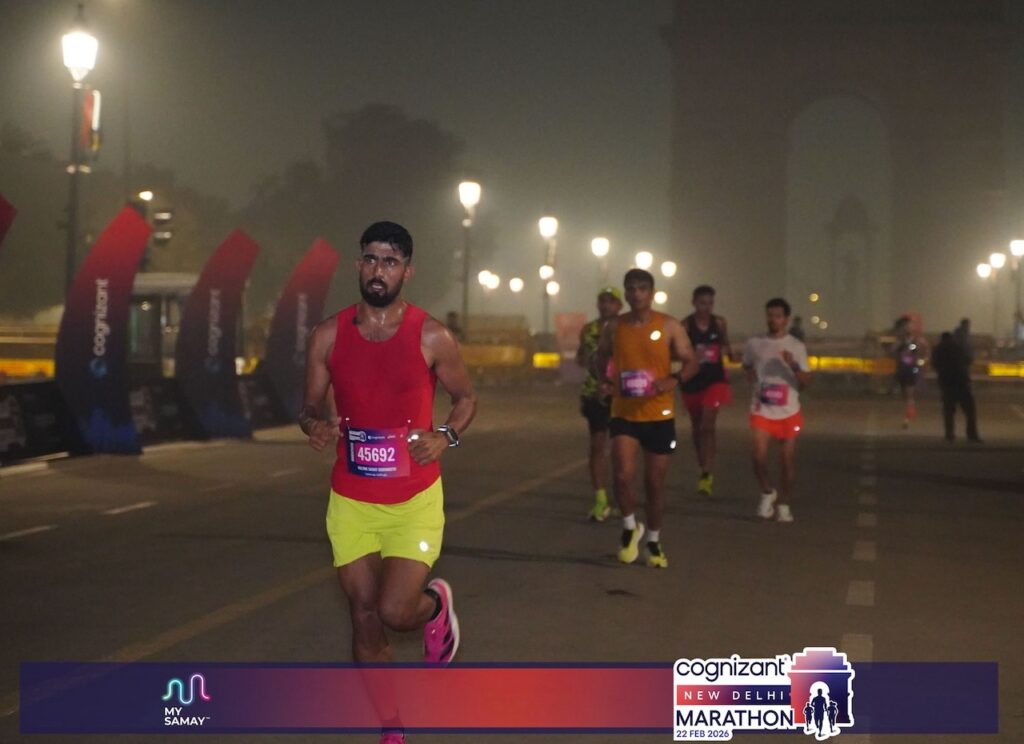
Why would runners transfer their bibs to other runners? Why would men run with bibs meant for women? Why would a bib be copied and used by multiple runners? Why would a coach become a ‘mule’ and carry bibs of trainees tucked in beneath his own? Besides, why would a runner produce Aadhar cards with different dates of birth in different events?
There appear to be many reasons for bib-swapping. From securing qualification times for prestigious races around the world to claiming bragging rights on Social Media; from running in mega road running events without paying the requisite entry fee (but claiming the finishers’ medal as a matter of right) to being genuinely injured and seeking to recover the amount paid as fee.
To be sure, bib-swapping is not just a local fancy. It is a global disease that has challenged, among others, organisers of the London Marathon, Boston Marathon and Hong Kong Marathon. It has made the Athletics Integrity Unit sit up and take note of such an instance in the Dresden Marathon in Germany in 2021.
The Athletics Integrity Unit imposed a six-month ban on Spain’s Camilo Santiago ad Honduras’ Ivan Zarco Alvarez after the former ran with the latter’s bib, completing the course in 2:17:36. Had the fraud not been detected, the time would have been a Honduras National Record and may have earned Ivan Zarco Alvarez a ticket to Tokyo 2020.
Sport is about values like friendship, excellence and respect. And these must always be held close to the hearts of athletes even in amateur events. These tenets are mocked at by those breaking rules with impunity. The sad thing is that not many cases are reported or detected since there is a sense of resigned acceptance and dismissed with a shrug as someone having harmless fun.
Of course, it can never be easy for organisers of mass participation events to detect, let alone eliminate, all instances that compromise the integrity of their events. But credit to Procam International and NEB Sports for being proactive in identifying dozens of cases and imposing bans on those involved in such unscrupulous practices.
Procam International disqualified the 2026 Tata Mumbai Marathon results of 49 runners and barred them from competing in the event next year as well. It imposed a harsher sanction on two runners who carried or used other registered participants’ bibs for the purpose of recording timing or race results.
On its part, Procam International reiterates that bib swapping, impersonation, or any attempt to manipulate time is a serious violation of race regulations. “These measures are necessary to protect participant safety, ensure fairness in competition, maintain qualification integrity and uphold the credibility of the event,” it says.
NEB Sports, which conducted the Cognizant New Delhi Marathon 2026, has published a list of 14 bibs for various transgressions. In the Mumbai Half Marathon, run in August 2025, NEB Sports was compelled to disqualify two women and a male runner for rule violations. However, the official website says the competition was clean and no participants were disqualified.
NEB Sports’ Nagaraj Adiga says the introduction of prize money for age-group categories could have led to a spike in attempts to cheat. He points out that organisers of marathons and endurance events have introduced colour coding of bibs and have used data and visual aids from around the route to establish cheating.
Many a time, only a complaint has led to investigation and eventual detection of fraud. There has been some instances of race directors being taken aback by those claiming podium finishes not having broken into a sweat and checking race data and visual evidence – photographs and videos from different locations on the route.
Yet, it may not suffice for race organisers to post only bib numbers of runners who have been disqualified from the races conducted by them. Besides naming the registered runners who have transferred their bibs, the organisers must also name the ones who run with such bibs that have not been assigned to them in the first place. Both sets of runners must be sanctioned.
If an athlete from Railways runs with a doctor’s wife’s bib, both must be identified and sanctioned; the District Collectors’ wife and the coach who ran a race with her bib must both be named and banned across all running events. A central database of all runners has become necessary, what with the sport gaining ground as having 23.5 per cent of all non-cricket sponsorship.
Most bandits, as bib-less runners gatecrashing into mass participation events are popularly known, may just be harmless participants seeking their moment in the sun (and the finisher’s medal rather unscrupulously) but some can put the genuine participants at risk, especially in events that start before or around dawn.
If the sport’s integrity and the safety of other athletes is being compromised in 26 events certified by AIMS (Association of International Marathons and Distance Races) and/or the Athletics Federation of India, it becomes incumbent that these organisations seek the names of such runners who have been sanctioned by the race organisers and publish them on their own websites too.
Photos: Courtesy NEB Sports
