
The eight-year ban imposed on Hangzhou 2022 Asian Games women’s Shot Put medallist, Kiran Baliyan sent shock waves in the sporting community since it was not aware that an allegation of tampering had been added to the presence of Metandienone in her urine sample collected in competition in May 2024.
A National Anti-Doping Disciplinary Panel (ADDP) handed the Shot Putter a four-year sanction for the presence of Metandienone and added another four years for tampering, concluding that Kiran Baliyan had deliberately poured water from a jet spray in the washroom to contaminate the sample. The ADDP rejected a third allegation of Whereabouts Failure.
Did NADA and DCOs follow rules to the hilt?
However, the high profile case has also shown that there is a need to tighten the anti-doping systems in India. From locating an athlete’s home to accurately completing the necessary documentation, from sticking to timelines in the results management process to making the reasoned decision public, the anti-doping mechanism can do with some refining.
There are at least two instances – evidenced by the admission that the athlete was not given a copy of the Supplementary Report Form and the failure of a DCO to locate her home because some NADA official had not entered the PIN Code when entering her address in the Mission Order – to show that the DCOs have done a shoddy job.
A comparison of the specific gravity of the two samples would have been sufficient to adjudicate the allegation. Besides, a study of the concentration levels of Metandienone in the two samples would also have assisted the Panel to arrive at a conclusion on the basis of scientific evidence rather than rely merely on a Supplementary Report that does not have the athlete’s signature.
There is a another larger question that needs to be asked. Should a tribunal consider a Dope Control Form or a Supplementary Report Form not signed by the athlete as a valid legal document? Perhaps not. Even if it chose to ignore an important technicality, the Panel should have pulled up the DCOs for not following procedure carefully.
There were good reasons for the Panel to reject that allegation – the chaperone’s admission that the athlete was not informed about the allegation of tampering being made; the Supplementary Report not being signed by the athlete; and a copy of that Report not being given to her as mandated in the rules.
On the one hand, the Panel relied on the Supplementary Report by Chaperone Paromita Saha and three DCOs to satisfy itself that tampering has been established. Yet, on the other hand, the panel rejected another DCO Ajay Kumar Dubey’s report because of material deficiencies emerging during his testimony before the panel.
Lapses in time
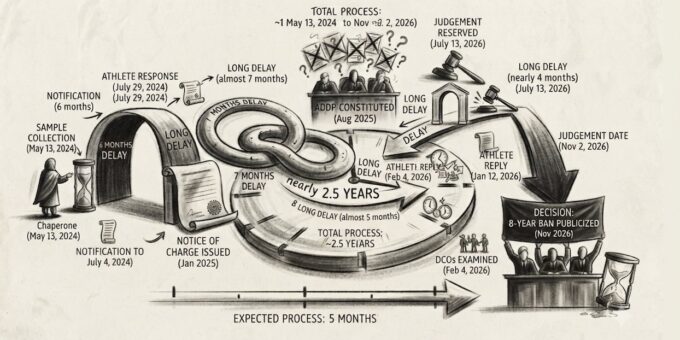
After Kiran Baliyan filed her response to NADA’s July 4, 2024, Notification about the presence of Metandienone in her sample, NADA took six months to issue her a Notice of Charge. Seven more months lapsed between then and the constitution of an Anti-Doping Disciplinary Panel (ADDP) with Charu Pragya as Chairperson and Dr. Skand Sinha and Abantika Deka as members.
While it is understandable that the athlete asked for a set of her supplements to be tested, the ADDP formation could have been done sooner. After three months of correspondence between the athlete and the Panel, the ADDP declare that her request to summon and examine witnesses was non maintainable.
Kiran Baliyan’s counsels Parth Goswami and Ranjeet Pawar were quick to move the Delhi High Court against that December 9, 2025, order. Justice Sachin Datta ruled that it was incumbent on the panel to permit the production of witnesses and their examination. Armed with the Court order, Kiran Baliyan filed her response to the Notice of Charge on January 12 this year.
Though hearings were complete and the ADDP order reserved on July 13, the panel took nearly four months before making its decision to ban Kiran Baliyan for eight years public earlier this month. The entire process, which could have been completed inside 5 months from the date of sample collection, lasted nearly two and a half years.
The Chaperone and DCOs involved in the sample collection were examined nearly 21 months after the sample was collected on May 23, 2024. Such a long gap could have been tough for the Chaperone to recall the incident with any degree of accuracy and detail. That would possibly make it important for interactions between athletes and DCOs to be video recorded.
Illustration (for representation purposes only) created with Google Gemini
