
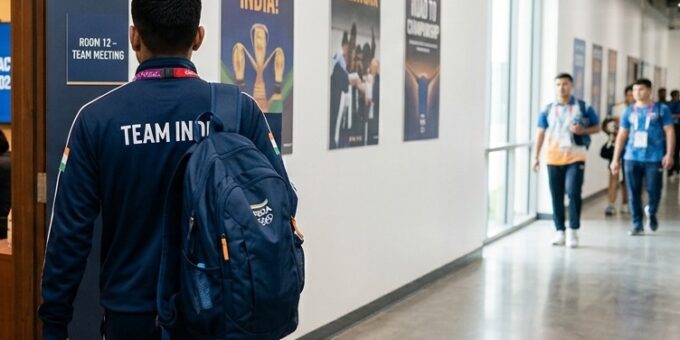
This was eminently avoidable, the drama of Team India having to send a weightlifter home from Glasgow even before the opening ceremony of the Glasgow 2026 Commonwealth Games. And to make it worse, the unseemly drama has its roots in the rising numbers of weightlifters who test positive for prohibited substances.
The Indian Weightlifting Federation of India picked the men’s 73kg class lifter Dilbagh Singh as the one who would have to fly back home in the wake of the Commonwealth Games Organising Committee direction that India could field only 11 athletes in the weightlifting competition as five of its lifters were sanctioned in the 13 months preceding the Games.
As many as 72 Indian weightlifters are currently serving bans but only five have confirmed Anti-Doping Rule Violations between June 1, 2025, and July 22, 2026, and are conclusively sanctioned by an Anti-Doping Organisation. That further shrank India’s quota, already reduced from 16 to 12 because of the sanctions against four lifters earlier.
The agreed decision on June 30 between a 23-year-old from Haryana identified as Shankar and the National Anti-Doping Agency increased the number from four. Sankar Logeswaran, Khushboo Kumari, Abhishek Choubey and Lalruatfela were the weightlifters who had been sanctioned earlier.
It would appear that everyone in the ecosystem overlooked the five-year ban on Shankar who was tested in competition in the IWLF National Weightlifting Championships on February 11 and tested positive for a cocktail of banned substances – Stanozolol, Drostanolone, Trenbolone and Mephentermine – before the agreed decision on June 30.
Clearly, those who in charge of selecting the team and those clearing it have been slack. They have been caught on the wrong foot, not only bringing ignominy to the contingent but also making an athlete go through a repatriation home before the competition for no fault of his own. It is hard to even begin to think what could be going through his mind at being made the sacrificial lamb.
If the Indian Weightlifting Federation and the Sports Authority of India had been diligent about the rules, things would not have come to such a pass, especially since the last known and confirmed Anti-Doping Rule Violation by an Indian weightlifter was announced three weeks back on June 30, a few days before the deadline to submit final entries by name.
Curiously, the Indian Olympic Association appears to have been persuaded to try and convince Commonwealth Sport to accommodate an extra Indian weightlifter on humanitarian grounds since the athletes responsible for the ADRVs were no longer part of the contingent. IOA should have not even have considered asking for such an exemption.
Was India preparing to field an injured athlete?
It also transpires that the Indian Weightlifting Federation chose Dilbagh Singh as the athlete to return home from Glasgow since he was unable to train in the run up to the Commonwealth Games owing to a back injury. It does appear that he would have competed but for the organisers telling India to reduce the number of weightlifters to 11.
That does raise a serious question about the propriety of the athlete being fielded despite an injury that prevented him from training adequately before the Games. Of course, it is possible for the injury to be managed so that conservative training could be factored in. If that were the case, making the athlete sound like an expendable now comes across as lacking empathy.
One dreads to think of the magnitude of the hit that India would have taken if the nine weightlifters, now provisionally suspended and awaiting adjudication, were sanctioned as well. For the Commonwealth Games rules state that for each ADRV, a team’s quota would come down by a corresponding number. A lean squad and leaner medal returns may have resulted.
N Ajith, Sairaj Pardeshi, Kritika Rana, a minor, Chelsi, SB Charukesh, Harcharan Singh, Vanshita Verma and Heena are listed among athletes serving provisional suspension as of July 3. Considering that at least three of these tested positive before March this year, it would be fair to surmise that delays in the adjudication process may have saved India a few berths in Glasgow.
Indeed, if slack administration led to the sad story of 21-year-old Dilbagh Singh, silver medalist in the Asian Championships last year, returning from Glasgow, slow processes elsewhere it may have benefit India, too.
Image: Generated by Google Gemini for illustration purposes only
