
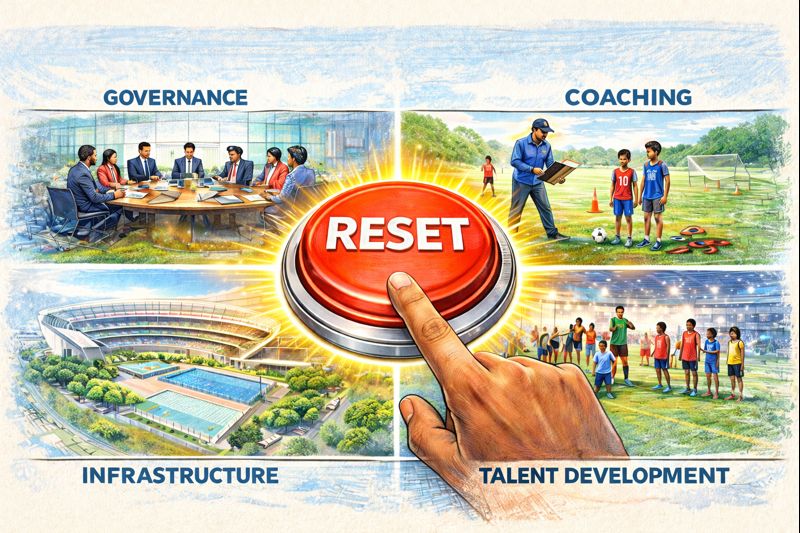
India has all but hit the reset button in its quest to become a sporting nation and figure in the top 10 of the Olympic Games table, even if it means that it has to start from the scratch in four key areas – governance of sport, coaching and scientific support, infrastructure development policy as well as talent identification and development.
The wheels have already been set in motion for governance reform through the National Sports Governance Act 2025; and well-designed plans for capacity building of sports administrators and the development of coaching ecosystem in India have been presented by the Task Forces headed by Abhinav Bindra and Pulella Gopichand respectively.
The Ministry of Youth Affairs and Sports got thought leaders like Abhinav Bindra and Pullela Gopichand to bring their thinking caps along to lead the Task Forces on Governance and Coaching respectively. While the Bindra Committee report has been shared in public domain, the Gopichand panel report has still not been made public by the Ministry.
Lop-sided Infrastructure development policy
The Ministerial thinktank would do well to also review the efficacy of its infrastructure development policy and of SAI schemes that form a critical part of talent identification along with competitions. There are some signs that the Ministry is aware of the severity of many of these problems but it is not known if Task Forces have been constituted to study these areas.
It was good to hear Ministry of Youth Affairs and Sports Secretary Hari Ranjan Rao recently shine a light on the inadequate focus on infrastructure planning. “We have built very good infrastructure, but we need to raise the numbers substantially. Also, do we have infrastructure in the disciplines where there are more medals (at stake in the Olympic Games)” he said.
It is clear that the time has come for the Ministry of Youth Affairs and Sports to invest resources at its disposal more wisely and with specific sporting targets in mind. The feeling is that infrastructure development has happened on whim, almost on a whim – the uncharitable say it has been used a political tool – rather than through a studied, need-based approach.
Talent Identification & Development pathways
Moving on to Talent Identification, there can be no gainsaying that India needs an immediate upgrade in the methods it has embraced so far. However, to say the least, stepping ahead without learning from the past would be ill-advised. If India has got thus far, it must have done something right. Besides, it would have done things that need vast improvement.
It is alright to aspire for an AI-led Talent Identification tool, but the portals of power must pause to reflect on the failure of KIRTI (Khelo India Rising Talent Identification). Launched with grand fanfare and relaunched with more fanfare, it had targeted assessing 20 lakh children but ground to a halt after just 1.87 lakh assessments.
Let us now shift to the Talent Development at various levels through SAI Schemes. These include National Centres of Excellence (NCoE), SAI Training Centres (STC), STC Extension Centres, National Sports Talent Contest (NSTC) Scheme, Adopted Akharas and Indigenous Martial Arts (IGMA) Schools. More than 72 per cent of these are residential athletes.
A look at the statistics (2024-25) shows that there are less than 9500 athletes in the SAI Schemes, including nearly 3500 in the NCoEs. It indicates that for every 10 athletes in NCEOs, only 17 athletes are in the lower rungs. Clearly, this is an inadequate ratio, since larger sections at the grassroots and development levels can ensure a thicker creamy layer in the future.
The top 10 sport in terms of number of athletes supported through SAI Schemes are Wrestling (1298), Hockey (1114), Boxing (972), Athletics (881), Football (569), Archery (479), Taekwondo (395), Judo (371), Volleyball (352) and Weightlifting (319). At the other end are Shooting (173), Rowing (149), Table Tennis (136), Swimming (108) and Badminton (75).
No athletes from many major disciplines in SAI Schemes
Worse, it defies understanding that not a single athlete from Asian Games medal winning sports like Tennis, Sailing, Squash, Cue Sports, Equestrian, Board Games, Golf, Diving, Roller Sports, Water Polo and Kurash is in any of the SAI Schemes. Sadly, no Winter Sports discipline figures in the list.
And, viewed from a gender perspective, it is skewed in favour of the males who form 60 per cent of the total athletes in all SAI Schemes. For all the talk about gender neutrality and the awareness that women athletes can win more medals for India, the ratio is skewed in favour of male athletes.
For every 100 male athletes across the SAI Schemes, there are just 67 female athletes. Things are healthier in NCOEs where for every 100 male athletes, as many as 91 female athletes find support. At the lower rungs, this drastically reduces to 35 female athletes for every 100 male athletes.
If India truly wishes its aspiration to win 30-35 medals in 2036 Olympics, it has to not only galvanise more girls to play sport but also spread its net wider in terms of disciplines in which it can develop athletes who can win medals for India. And, if it is not already too late, work on that front must start now.
To be sure, there are other streams from which high performance athletes emerge, not just from the SAI schemes. There are States and Union Territories that have their own programmes while there are clubs and academies that form critical rungs in the ladder that an athlete needs to rise to the higher echelons of his or her sport.
Of course, there are also 29214 athletes who train in 915 Khelo India centres across the country but since a vast majority of these are not part of SAI Schemes, it can be assumed that their training and development is perhaps not yet aligned with the larger goal of taking India to the top 10 in the Olympic charts in 2037 and in the top 5 in 2048.
The Ministry is alert to the fact that school sport and college/university sport have long ceased to be the talent pipelines as in the past, leaving the National Sports Federations to conceive and depend on age-group sport to be the earliest rungs in talent identification and development. If a turnaround can be achieved on this front, India can only benefit in the long run.
Photo: Created with ChatGPT
